

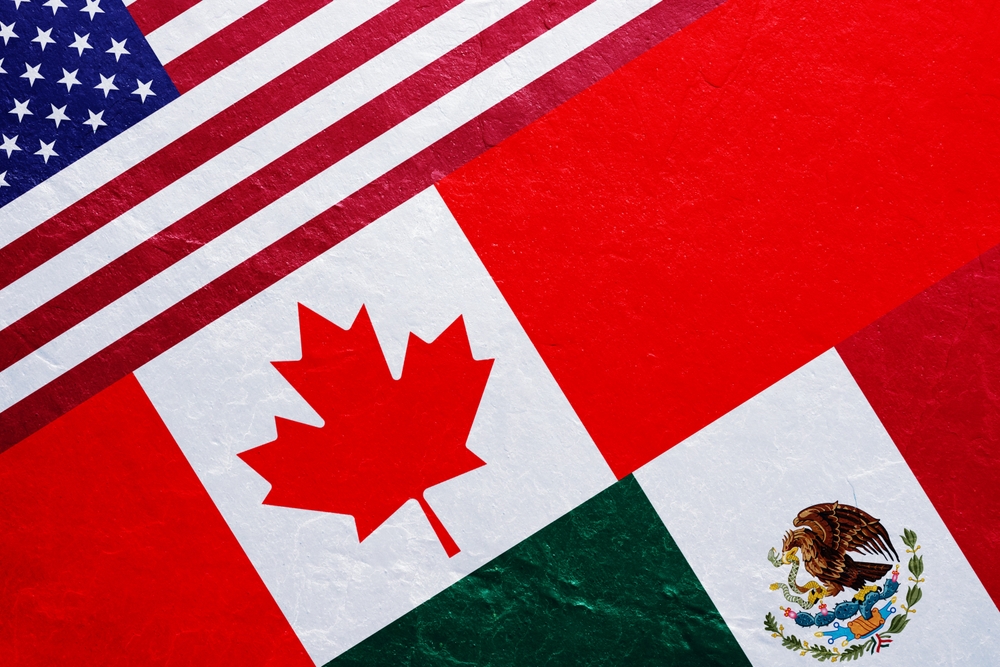
Commitment to Three-Nation Framework
Canada and Mexico remain committed to a trilateral review of the United States-Mexico-Canada Agreement, even as Washington signals interest in pursuing separate bilateral arrangements.
Dominic LeBlanc, Canada’s minister responsible for Canada-U.S. trade, reaffirmed that position after meetings in Mexico with President Claudia Sheinbaum and Economy Secretary Marcelo Ebrard. LeBlanc led a delegation of roughly 250 Canadian companies during the visit.
“We both remain absolutely committed to the trilateral free-trade agreement,” LeBlanc said during a virtual press conference from Monterrey, while acknowledging that both Canada and Mexico are also addressing certain bilateral issues with the United States.
High-Stakes Review Deadline Approaches
The three countries are preparing for a July 1 deadline to determine whether the trade pact will be renewed for another 16 years or shift to annual reviews. Under the agreement’s terms, any party can withdraw with six months’ notice.
President Donald Trump has suggested multiple times that the U.S. could exit the pact and pursue bilateral deals instead. U.S. Trade Representative Jamieson Greer recently indicated that negotiations on certain matters would proceed separately with Canada and Mexico, describing Canada as the more challenging counterpart.
LeBlanc said some issues will be handled bilaterally while others, including rules of origin, require trilateral coordination. The United States is seeking stricter regional content requirements and closer alignment on external tariffs, investment screening and export controls.
Policy Differences and Common Ground
Recent trade policy decisions highlight differences between Ottawa and Mexico City. Mexico has raised tariffs on China and other non–free trade partners. Canada, meanwhile, reduced tariffs on some Chinese electric vehicles and invited Chinese investment into its automotive sector.
LeBlanc characterized the divergence as a reflection of differing economic structures and sectoral priorities rather than a breakdown in alignment. He expressed optimism that Canada and Mexico could find common ground with each other and with the United States on key issues raised in the review process.
Business Ties Take Center Stage
Beyond diplomatic discussions, the trade mission focused heavily on strengthening Canada-Mexico commercial relationships. The Canadian Trade Commissioner Service facilitated nearly 2,000 business-to-business meetings across Mexico City, Monterrey and Guadalajara.
Candace Laing, chief executive of the Canadian Chamber of Commerce, said the mission’s format was especially beneficial for small and medium-sized companies seeking market entry support. Dennis Darby, president of Canadian Manufacturers & Exporters, emphasized that relationship-building in Mexico often requires multiple visits and sustained engagement.
As negotiations over the future of the USMCA intensify, both governments appear intent on preserving the three-nation framework while also navigating evolving political and economic pressures from Washington.