

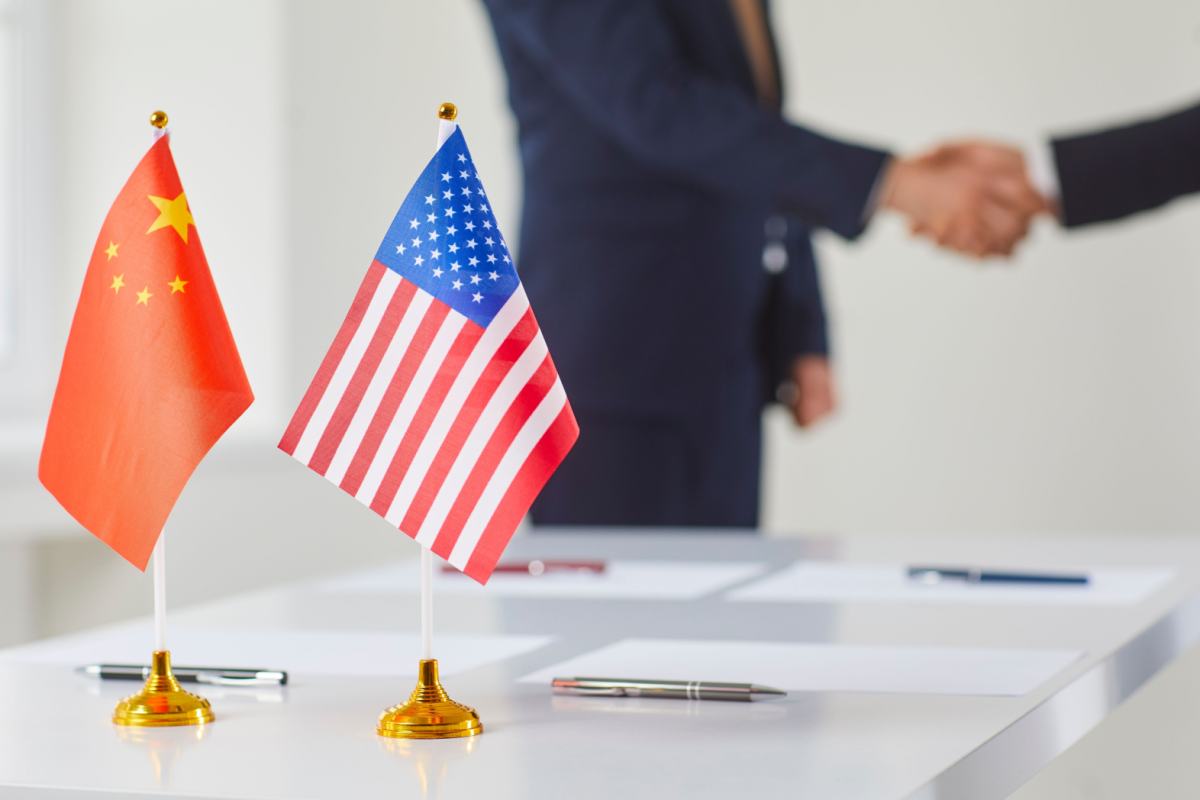
U.S.-China Talks Aim to Stabilize Global Markets
Presidents Donald Trump and Xi Jinping are set to hold their first in-person meeting since 2019 on Thursday, with expectations of striking a deal to ease trade tensions between the world’s two largest economies. The meeting, taking place on the sidelines of the Asia-Pacific Economic Cooperation (APEC) summit in Gyeongju, South Korea, could have major repercussions for the global economy.
Together, the United States and China account for nearly 43% of global GDP and almost half of the world’s manufacturing output. Their two-way trade reached $585 billion in 2024, underscoring their economic interdependence. Analysts warn that a renewed trade war or full economic decoupling would deal a significant blow to global growth, potentially reducing worldwide GDP by nearly 7% over time, according to the World Trade Organization.
De-Escalation Expected After Months of Confrontation
The summit follows months of escalating rhetoric and retaliatory measures between Washington and Beijing. Earlier this month, China announced export controls on rare earth minerals — key materials for everything from smartphones to fighter jets — sparking fears of global supply chain disruptions. In response, President Trump threatened to impose an additional 100% tariff on Chinese imports, raising the specter of an economic standoff.
However, both sides now appear ready to step back from the brink. U.S. Treasury Secretary Scott Bessent indicated that Trump and Xi are expected to agree to delay new tariffs and suspend China’s export restrictions. Economists say such steps could calm financial markets and restore short-term investor confidence. “De-escalating the trade war, and perhaps even more important, the tech war, is of huge importance for the world economy,” said Rolf J. Langhammer of the Kiel Institute for the World Economy.
Global Stakes and Fragile Stability
Experts caution that while a temporary truce may stabilize markets, deep structural differences remain. “The U.S.-China relationship is the most important bilateral relationship,” said Heiwai Tang of the Asia Global Institute in Hong Kong. “Any de-escalation in their tension will have significant implications, especially for smaller economies that rely on trade with either superpower.”
The International Monetary Fund (IMF) recently raised its global GDP forecast for 2025 to 3.2%, reflecting cautious optimism as tariffs have been delayed or reduced since Trump’s “liberation day” announcement in April. Still, the IMF and other global institutions warn that renewed U.S.-China conflict could reverse that progress quickly.
Long-Term Frictions Remain Unresolved
Despite expectations of a modest trade thaw, analysts doubt that Trump and Xi will achieve lasting reconciliation. Jacob Gunter of the Mercator Institute for China Studies in Berlin noted that “the fundamental incompatibility of the two superpowers’ economic models has become impossible to ignore.” He said it was difficult to imagine China abandoning its state-led, export-oriented model, or the U.S. lifting restrictions on Chinese technology and imports.
“These irreconcilable differences exist,” Gunter said. “I just don’t see any deal that would be sufficient enough to meet the interests and values of both parties that wouldn’t come at the expense of the other.”
As Trump and Xi prepare for their long-anticipated summit, markets and policymakers alike are watching closely. Even a symbolic truce could offer a much-needed pause in a volatile era of trade and technology competition — but few expect it to mark the end of the U.S.-China rivalry.