

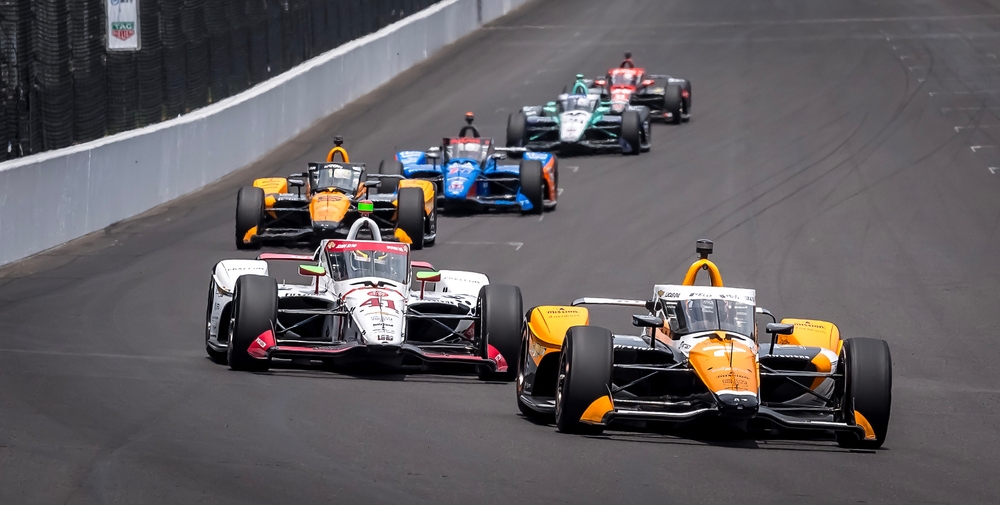
New street race stays clean until a late caution
IndyCar’s arrival in Arlington produced a rare kind of street race: one shaped less by disorder than by sustained execution. On a layout that could easily have generated repeated interruptions, the field instead ran deep into the afternoon without a full-course yellow, turning the inaugural event into a contest of timing, control and outright pace. That unusual rhythm gave the race a distinctly strategic character and set the stage for a direct late fight between two of the day’s quickest drivers.
When the decisive moment came, Kyle Kirkwood seized it. With 15 laps remaining, the Andretti Global driver attacked Alex Palou and moved ahead with a forceful pass that settled the battle for victory. From there, Kirkwood managed the closing phase and took the win, while Palou finished 0.3140 seconds behind in second. Will Power completed the podium in third, giving Andretti two cars in the top three and underlining the team’s strength on the new circuit.
Marcus Ericsson added a fourth-place finish for Andretti, and Pato O’Ward rounded out the top five for Arrow McLaren. Taken together, the results reflected a race in which the fastest teams largely stayed in control. Rather than being reshaped by repeated cautions, Arlington rewarded those that could maintain position, execute pit cycles cleanly and respond when the pressure rose late.
Kirkwood delivers again on a street circuit
The victory was the sixth of Kirkwood’s IndyCar career and his fourth on a street course, further strengthening a profile that is increasingly defined by performance on temporary circuits. His late overtake on Palou was the key sequence of the race, both assertive and clean, and it came after a long stretch in which passing chances had been limited by the race’s uninterrupted flow.
Palou still emerged with a strong points result after spending much of the event in control of the contest at the front. The Chip Ganassi Racing driver remained close in the final laps but could not reclaim track position once Kirkwood moved ahead. His second-place finish nonetheless reinforced his consistency in races where tire life, rhythm and composure matter more than opportunistic restarts.
Power’s podium was also significant. Third place marked his first top-three finish with Andretti and added to a broader team result that stood out across the top of the order. Ericsson’s fourth-place finish meant Andretti placed three cars inside the first four positions, a reflection not only of car speed but also of operational sharpness over 70 laps. O’Ward’s fifth-place run kept Arrow McLaren in the conversation, though the team lacked the final edge needed to challenge the leading pair for victory.
Strategy mattered more than survival
Street races are often defined by interruptions, but Arlington unfolded differently. The absence of a full-course yellow until the final four laps created long green-flag runs that placed greater weight on pit timing and race management. Most of the front-runners stopped three times, though Power reached the podium with only two pit visits, giving his afternoon a slightly different strategic profile from those around him.
That uninterrupted structure also exposed any loss of track position. Scott Dixon, despite his experience and race craft, had to make four pit stops and finished eighth. Marcus Armstrong also required four stops and still managed 10th. Kyffin Simpson made six visits to pit lane and dropped to 19th, illustrating how little room there was to recover in a race that stayed green for so long. Arlington therefore became a test of efficiency rather than improvisation, with fewer external disruptions to mask mistakes.
The closing phase did finally introduce the kind of drama more commonly associated with street racing. A late caution compressed the field and created a one-lap restart, but the race did not end with a clean sprint to the line. Another incident in the back prevented a full finish under green, leaving the order locked under caution and removing any final chance for Palou to counterattack.
Penalty reshuffles midfield and rookies gain ground
The classification changed after the flag when Felix Rosenqvist, initially sixth on the road, was penalized for jumping the final restart. The decision dropped him to 20th, promoting David Malukas to sixth and moving Christian Lundgaard, Dixon, Alexander Rossi and Armstrong each up one place. The adjustment significantly altered the look of the midfield and ensured that Rosenqvist’s apparent recovery yielded almost nothing in the final result.
Among the rookies, Caio Collet delivered the most notable performance. The A.J. Foyt Enterprises driver finished 12th, the best result of his IndyCar career and an improvement on his previous high of 17th. Louis Foster followed in 13th, while Dennis Hauger came home 16th. Mick Schumacher, after a five-stop race, finished 22nd in a tougher afternoon for the Rahal Letterman Lanigan Racing newcomer.
Further back, late incidents caught out several drivers. Romain Grosjean and Nolan Siegel were both classified after collisions, while Christian Rasmussen retired after an accident. Even so, those moments did not define the race. The first Grand Prix of Arlington was notable precisely because it resisted the normal pattern of a street event. It stayed composed, built naturally toward a late fight for the lead and gave Kirkwood the platform to add another street-course win to his record.