

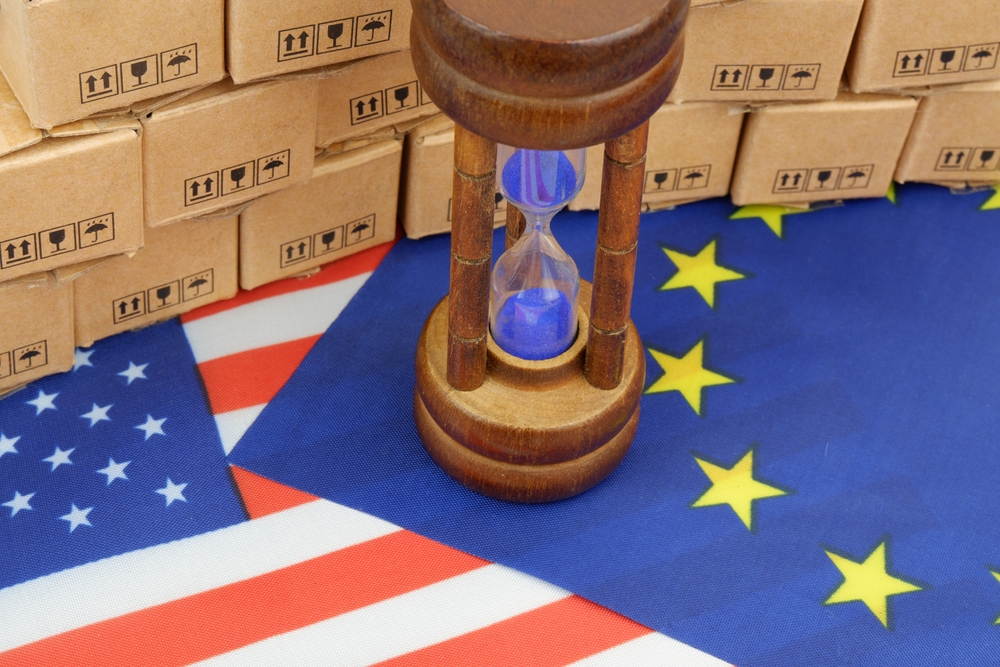
Parliament approves the pact while reserving the right to suspend it if Washington crosses key red lines
The European Parliament has approved the trade deal between the European Union and the United States, but not without adding a protective layer designed to shield European interests if Washington fails to respect the spirit or terms of the agreement. The vote marks an important step toward implementation, yet it also shows that European lawmakers are no longer willing to treat trade policy as separate from wider political and strategic tensions.
The deal itself was negotiated last July by Donald Trump and Ursula von der Leyen in Turnberry, Scotland. Its central purpose was to avoid a much more severe tariff escalation by fixing a 15% tariff on most goods instead of allowing a broader trade confrontation to develop. That arrangement was always controversial inside Europe because it was seen by many as a compromise made under pressure rather than a balanced long-term settlement.
Now, Parliament has made clear that any economic stability provided by the agreement comes with conditions. Lawmakers inserted language allowing the deal to be suspended if the United States is judged to have undermined its objectives, discriminated against European companies, engaged in economic coercion or threatened the territorial integrity, foreign policy or defense interests of EU member states. That wording transforms the agreement from a simple trade mechanism into something closer to a politically conditional truce.
Greenland became the issue lawmakers refused to ignore
The most politically sensitive addition to the deal is the clause shaped by tensions over Greenland. European officials made little effort to hide that point. The safeguard was crafted specifically because of the alarm caused by Trump’s earlier threats involving the Arctic territory, which belongs to the Kingdom of Denmark and carries obvious implications for European sovereignty and strategic cohesion.
That matters because it shows how much the relationship between trade and geopolitics has changed. A few years ago, a commercial accord like this might have focused narrowly on tariffs, quotas and industrial access. This time, lawmakers wanted explicit protection in case Washington once again uses economic leverage while simultaneously challenging the territorial or political interests of a member state.
The message from Parliament is therefore not subtle. Europe is still willing to do business with the United States and to preserve transatlantic trade stability, but it no longer assumes that economic cooperation can survive independently of political behavior. If the Greenland issue returns in a more aggressive form, the trade deal itself could become part of the response.
The vote supports the deal, but with visible caution
The parliamentary backing was solid, with the two amendment votes both passing comfortably. That gives the agreement a strong procedural foundation and sends a reassuring signal to businesses that have spent months operating in uncertainty. Yet the support was not a sign of unconditional enthusiasm. It was support filtered through distrust, legal caution and a recognition that the agreement may still need to withstand future shocks.
This is why the added clause matters so much. Parliament is effectively saying that the deal should deliver predictability for European firms, but that predictability cannot come at the expense of political vulnerability. In that sense, the approval is both pragmatic and defensive. Brussels wants the commercial benefits of a functioning trade arrangement, while also keeping a mechanism ready in case Washington turns destabilizing again.
The size of the transatlantic relationship explains why lawmakers did not want to block the agreement outright. Trade in goods and services between the European Union and the United States is enormous, spanning everything from pharmaceuticals, chemicals and cars to cloud services, energy and aerospace. An uncontained tariff conflict would have created serious disruption on both sides.
Negotiators now move into the next phase
The parliamentary vote does not finish the process. It strengthens the EU position going into the next round of talks between trade officials on both sides, with further negotiation still needed over how the agreement will be enforced and how the new protective language will operate in practice. That next phase is likely to determine whether the deal becomes a stable framework or remains a fragile arrangement constantly exposed to political disruption.
For European businesses, the vote offers some relief because it points toward greater clarity after months of delay and uncertainty. For policymakers, however, the bigger significance lies elsewhere. The agreement is no longer just about tariffs. It has become a test of whether the European Union can preserve economic cooperation with the United States while defending itself against political pressure from the same partner.
That is what makes this vote more consequential than a normal trade approval. Parliament did not simply say yes to the deal. It said yes with a warning attached. The EU still wants the transatlantic marketplace to function, but it is now building that relationship on a more guarded basis, with fewer illusions and a stronger willingness to link commerce to sovereignty. If tensions flare again, especially over issues like Greenland, Europe has made sure the trade pact can become a line of defense rather than a source of constraint.