

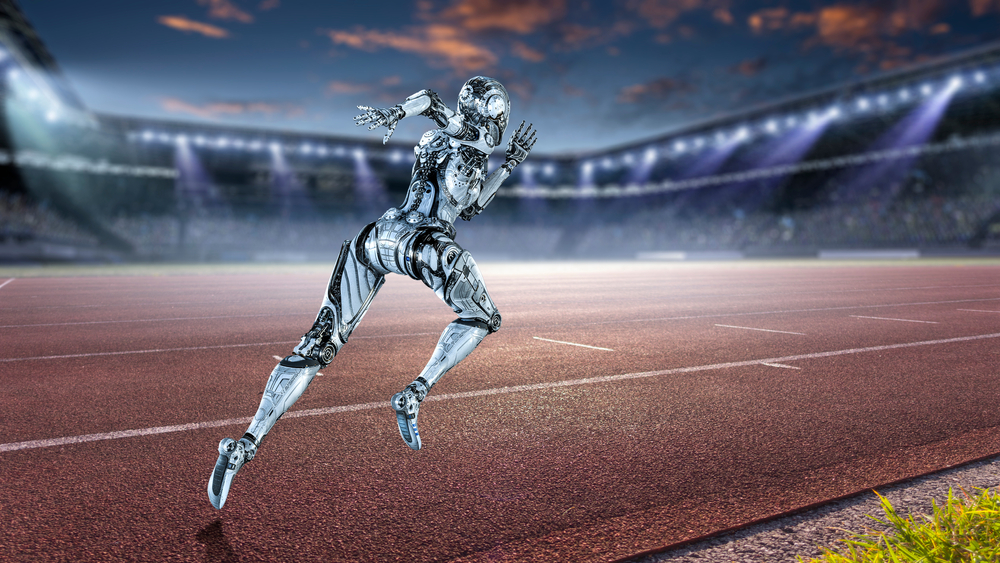
What looked like a publicity stunt ended up feeling more like a statement of intent. In a half-marathon in Beijing that pitted humans against humanoid robots, one machine did not just win its category or outperform expectations. It outran every human competitor in the field and did so by a huge margin.
The winning robot, a bright-red humanoid named Lightning, completed the 13-mile race in 50 minutes and 26 seconds, comfortably ahead of the fastest human runner and even faster than the current human world-record pace for the distance. The image is almost absurd on first reading: a robot crashes into a railing near the end, is lifted back up, and still storms to the finish. But the wider meaning is much more serious.
China is no longer presenting humanoid robotics as a distant experiment. It is showcasing them as a rapidly improving technology, capable of operating in public, under pressure and at speeds that would have seemed implausible only a year ago. This race was not just about sport. It was about credibility, ambition and technological rivalry.
From Embarrassment To Domination In One Year
The contrast with last year’s event is striking. In the inaugural edition, many of the participating robots stumbled, lost control or simply failed to finish. Only a handful made it to the end, and the fastest machine was nowhere near elite human athletic performance. The event was interesting, but it still looked like a chaotic demonstration of how far the field had to go.
This year was completely different. Not only did the winner dominate, but several humanoids posted times under one hour, a dramatic leap in capability. The improvement was so sharp that the tone of the event changed. What had once looked experimental now looked competitive.
That matters because rapid progress, rather than perfection, is often the clearest sign that a technology is moving into a more serious phase. China wanted this race to show momentum, and that is exactly what it did.
The Machines Were Fast, But Also More Stable
Speed alone would have impressed. What made the event more important was that the robots also appeared much more reliable. Many were able to handle turns, uneven surfaces and race conditions without the kind of public collapse that defined the earlier edition. Some still suffered mishaps, but those failures now looked like exceptions rather than the dominant story.
That improvement is crucial because the real commercial future of humanoid robots will depend less on dazzling headlines than on repeatable, stable performance. A machine that can move fast once is interesting. A machine that can keep functioning under stress in a semi-autonomous environment begins to look commercially relevant.
In that sense, the Beijing race was not only a spectacle. It was a public stress test for systems that may soon be sold into much more serious applications.
China Wants To Turn Robotics Into An Industry
Behind the race lies a much larger national strategy. China is investing heavily in robotics and artificial intelligence through a top-down model that combines state subsidies, industrial planning and visible public showcases. The country already has a large number of robotics firms and research groups, and events like this help convert technical progress into public excitement and commercial interest.
The incentives are not symbolic. Officials said the winning robot could attract orders worth more than a million yuan, which shows how directly the event is tied to future business. This is not technology for admiration alone. It is technology being positioned for procurement, scale and export.
The broader message is unmistakable: China does not want to be one player among many in humanoid robotics. It wants to dominate the category the way it has already built powerful positions in other strategic technologies.
This Is Also About The U.S.-China Tech Rivalry
The race inevitably feeds into the wider competition between China and the United States over advanced AI systems, chips, robotics and industrial leadership. Humanoid robots combine several of the most important frontiers in technology at once: sensing, motion control, batteries, semiconductors and increasingly sophisticated AI models.
That is why these machines matter politically as well as commercially. A country that can lead in humanoid robotics is not only building useful products. It is demonstrating strength across a whole stack of enabling technologies. China understands that symbolism perfectly, and it is using highly visual events to reinforce it.
In that sense, Lightning’s victory was not just a sports-style headline. It was part of a larger geopolitical narrative about who is setting the pace in the next generation of intelligent machines.
The Spectacle Still Revealed The Limits
For all the progress, the event also showed how far the field still has to go. Teams of technicians followed robots through the course, and some machines still fell, malfunctioned or needed improvised repairs. One robot reportedly continued after a fall with parts held together by packing tape. Another finished, then veered off and fell into a bush.
Those moments matter because they prevent the event from being mistaken for a sign of complete maturity. The bodies of these machines are becoming faster and stronger, but their autonomy, judgment and resilience still remain uneven. Even the most enthusiastic engineers often admit that the hardware is advancing faster than the machine intelligence guiding it.
That gap is central. Humanoid robotics can look remarkably advanced in motion while still lacking the flexible reasoning and situational awareness needed for truly broad real-world deployment.
The Real Prize Is Daily Utility
The long-term vision goes far beyond racing. Supporters of the technology imagine humanoids repairing infrastructure, working in factories, assisting in dangerous environments and eventually helping care for aging populations. That is the real commercial horizon, and races like this are only a dramatic preview of what companies hope to build toward.
What investors and policymakers want to know is not whether a robot can run a half-marathon once, but whether it can become reliable enough, cheap enough and smart enough to perform useful work at scale. China is betting that the answer will increasingly be yes, and it is building the industrial ecosystem accordingly.
The Beijing event therefore matters for a simple reason: it transformed humanoid robotics from something easy to dismiss into something harder to ignore. The machines are still imperfect. But they are improving fast enough that the future they suggest no longer feels remote.