

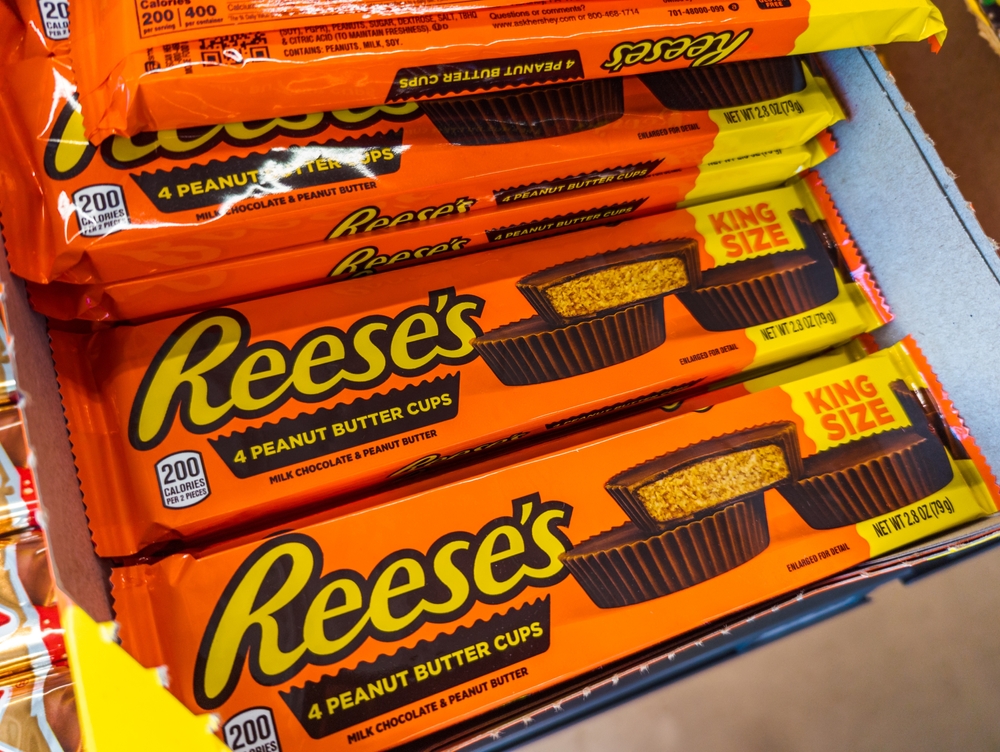
Hershey is moving to revise parts of its confectionery portfolio after criticism over ingredient changes in some Reese’s products sparked unwanted attention around one of its most important brands. The company said it will bring a portion of Hershey’s and Reese’s offerings back in line with their classic milk and dark chocolate recipes by 2027, while also updating KitKat to deliver a creamier chocolate profile and shifting its sweets portfolio toward colors from natural sources.
The decision matters because it touches on a sensitive issue for large consumer brands: how far a company can push cost management and product reformulation before it risks weakening the trust attached to its flagship products. In Hershey’s case, the pressure came into public view after Brad Reese, grandson of Reese’s founder H.B. Reese, accused the company of replacing core ingredients in some products with cheaper alternatives, an allegation that gained traction on social media and added an unexpected reputational challenge to the chocolate maker.
Although Hershey did not publicly credit Reese for forcing the issue, its updated product plans strongly suggest the company is responding to concerns that some line extensions may have drifted too far from the formulas consumers associate with the brand. For a business that depends heavily on familiarity, nostalgia, and taste consistency, even a limited perception of decline can become a commercial problem.
Recipe changes become a brand governance issue
The controversy centered on claims that Hershey had used compound coatings instead of milk chocolate and peanut butter style crème instead of traditional peanut butter in some Reese’s products. Brad Reese argued that such changes undermined the very ingredients that built consumer confidence in the brand. In his public criticism, he framed the issue not as simple nostalgia, but as a governance and stewardship question around what Reese’s is supposed to represent.
That criticism landed because Reese’s is not just another product in Hershey’s portfolio. It is one of the company’s most recognizable and commercially valuable brands, carrying decades of equity built on a very specific combination of chocolate and peanut butter. When consumers suspect that formula has been diluted for margin reasons, even if only in selected shapes or seasonal variants, the reputational risk extends beyond one limited edition product.
Hershey has pushed back on the broadest version of the accusation. The company stressed that the core recipes for its standard Hershey’s chocolate bars and Reese’s peanut butter cups have not changed. It also said recipe adjustments have been used in some innovations and special formats to accommodate new shapes, sizes, and product concepts while protecting what makes Reese’s distinctive.
Hershey signals a partial return to classic formulas
Even with that defense, Hershey’s latest messaging indicates it sees value in moving closer to its original product identity. At an investor event in New York, chief growth and marketing officer Stacy Taffet said the company would ensure that all Hershey’s and Reese’s offerings are consistent with their brands’ classic milk and dark chocolate recipes. Bloomberg later reported that the group would phase out a chocolate compound coating in certain Hershey and Reese’s products by 2027.
The company’s formal statement reinforced that direction. Hershey said the changes are part of a broader commitment to making products consumers love, and that the 2027 enhancements will include more natural colors across the sweets portfolio, a creamier KitKat recipe, and efforts to align a small portion of remaining Hershey’s and Reese’s items with classic formulations.
The wording is carefully calibrated. Hershey is trying to reassure consumers that the heart of its best known brands remains intact, while also acknowledging that some products at the margins will be brought back into closer alignment with traditional expectations. That approach allows the company to respond to criticism without conceding that its core recipes had been compromised.
The timing reflects both pressure and opportunity
The company’s response comes after the issue began to circulate widely online and coincided with a period in which Hershey’s stock lost some momentum. Shares fell as the ingredient debate gained attention, raising concern that the brand controversy could weigh on sales in the near term. Since then, the stock has traded more sideways, even though Hershey has often been viewed as a defensive name during broader market volatility.
At the same time, the company remains in a relatively strong financial position. Shares are still up 14% this year, supported by expectations that earnings and sales will benefit from significant price increases, easing cocoa costs, and continued expansion into adjacent snacking categories. Hershey also reiterated its fiscal 2026 outlook and maintained expectations for 15% to 20% earnings per share growth in fiscal 2027.
That creates a more nuanced picture than the controversy alone suggests. Hershey is not responding from a position of weakness so much as from a position of caution. It appears to have concluded that while selective formulation changes may have supported profitability, preserving long term brand credibility is more important than extracting incremental margin from products consumers view as iconic.
Investment in taste and trust becomes part of the strategy
Hershey said the changes are backed by a 25% increase in research and development spending, aimed at talent, technology, and nutrition science across its broader snack portfolio. That detail is important because it suggests the company wants to frame the recipe updates not as a defensive retreat, but as part of a larger strategy to improve product quality while modernizing the business.
The history behind the brand helps explain why the issue resonated so strongly. H.B. Reese created the Reese’s Peanut Butter Cup in 1928 in the basement of his home in Hershey, Pennsylvania. His family later sold the business to Hershey in 1963 in a deal reportedly worth $23.5 million in stock. That heritage gives the brand a deeper emotional and cultural identity than many packaged food products, which makes ingredient debates especially charged.
For Hershey, the lesson is clear. Consumers may tolerate innovation, seasonal variation, and portfolio expansion, but only up to the point where those changes appear to compromise the taste and identity that made the brand successful in the first place. By promising a return to more classic formulations in selected products, the company is trying to show that it understands the difference between product evolution and brand erosion.